
Check the Brantley County Owner-of-Record Card
The Brantley County Tax Assessor's qPublic record shows whose name the assessment roll carries today, and it is the first stop for a parcel check. Treat it as an administrative record. Tied to the tax parcel, it does not guarantee that every recent conveyance has reached the roll. Read the fields together and save the parcel ID.
| Owner / Owner Information | The person, estate, trust, or entity presently carried on the roll |
|---|---|
| Mailing Address | The destination for assessment correspondence, not necessarily the property |
| Situs Address | The physical parcel location, which can be blank for rural or vacant tracts |
| Parcel ID | The tax-map key connecting the card, bill, map, and deed research |
| Last Sale / Deed Reference | A clue to the recording date or book/page, subject to live-card verification |
| Legal Description | Lot, block, subdivision, land-lot, district, or metes-and-bounds shorthand |
Field labels on a Brantley parcel card can change. Check the current layout in the official qPublic search. One caution matters. An occupant may not be the owner. An out-of-county mailing address is normal when tax notices go elsewhere. The Tax Assessor's official landing page gives the current portal route and office notices:
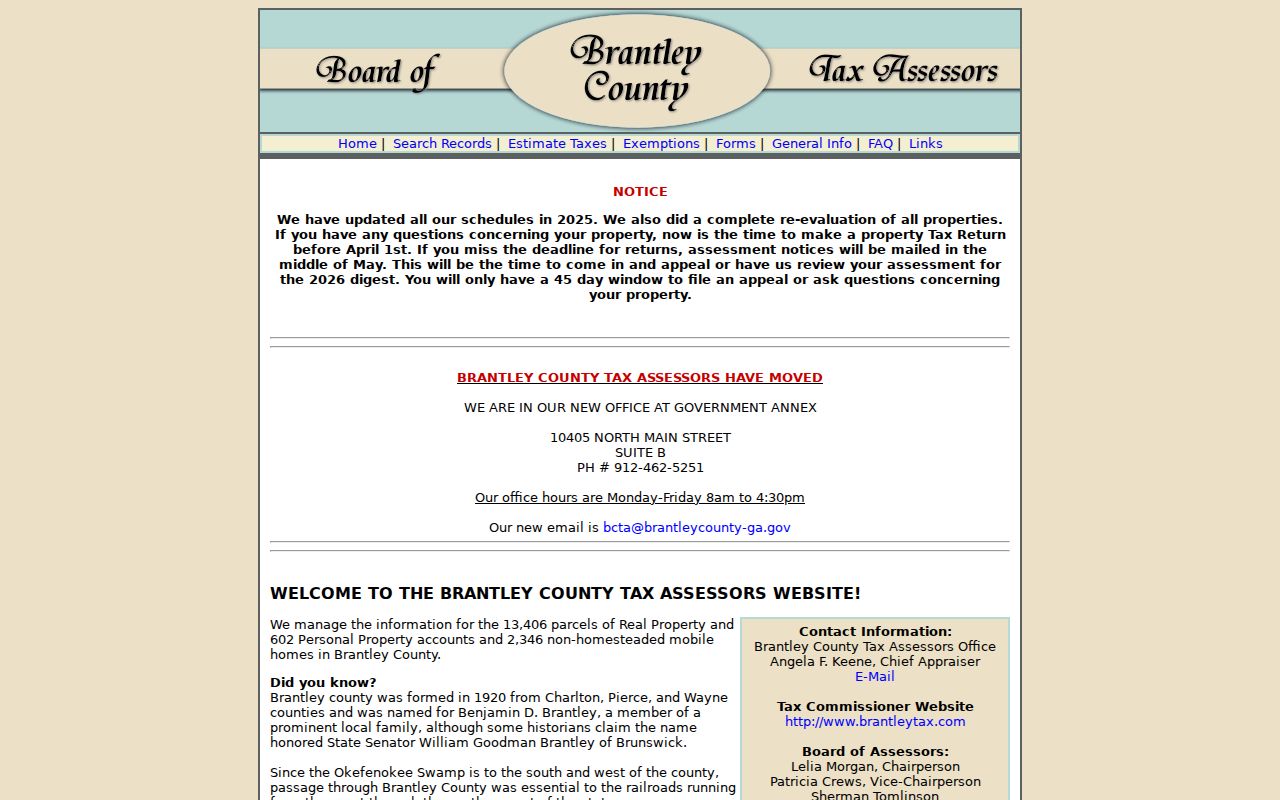
That page confirms the proper custodian. It is not a selected owner record, though, so open an actual parcel result before treating any displayed owner as the current one.
Measure How Current Brantley's Owner Record Is
Timing is the real question. Brantley County publishes no fixed interval between a deed's recording and the assessor's owner update. That gap matters most after a closing. Compare the roll's owner name and sale reference with the newest filing date in the GSCCCA Real Estate Index, whose statewide transaction coverage reaches at least January 1, 1999 while historical material continues to be added. Valuation news adds context. The assessor updated schedules in 2025. A full re-evaluation followed for the 2026 digest. Neither proves a sale. A new value and an old owner name can coexist, so a value update must never be mistaken for a conveyance.
Recent-sale gap. The assessment roll can lag a closing. When the names differ, the newest recorded deed is the more current public transfer evidence, but only a proper title examination resolves title.
Compare Brantley Mailing and Situs Addresses
The situs identifies the land or structure. The mailing line shows where tax mail goes. A P.O. box, care-of line, trust address, business office, or address outside Georgia does not make the card stale. Matching addresses may suggest owner occupancy, but they prove nothing. Postal geography creates false shortcuts. ZIP 31553 can cover Nahunta and rural areas, while 31542 covers Hoboken-area delivery territory. A postal city never sets municipal limits. It also does not change the county custodian of the parcel records. Start with Nahunta property records or Hoboken records for city-specific context. Then confirm the parcel through county sources.
Note: Preserve the source date beside each address; an address correction and an ownership transfer are different record events.
Confirm the Current Brantley County Owner
Confirmation stays in the present tense. The roll gives the current administrative name; the deed index gives the newest recorded conveyance. Skip the full historic chain here.
- Search the Brantley qPublic roll by situs address or parcel number and copy the owner name exactly.
- Use that name, county, recent date range, and any book/page clue in the GSCCCA search.
- Open the newest deed and match the grantee, parcel/legal description, and recording date to the assessment record.
- If the grantee is an entity, resolve the exact legal name and control number through Georgia's business search; if an estate is involved, check the probate transfer route.
- Owner of record
- The party presently shown in the assessor or recorded-property system.
- Assessment roll
- The administrative parcel list used for valuation and tax administration.
- Recording lag
- The unquantified period between a filed deed and an owner-field update.
- Registered agent
- An entity's official service contact, not necessarily the parcel owner or occupant.
Copies come from the Clerk of Superior Court. The office sits at 234 Brantley Street, Suite 200, Nahunta, reachable by phone at 912-462-5635 or by mail to P.O. Box 1067. GSCCCA eCertification handles account-based electronic certified-copy requests. For the full instrument or a longer chain, turn to Brantley deed records.
Verify a Current LLC, Trust, or Estate Owner
Entities show up often on the roll. The card may list an LLC, corporation, trust, estate, trustee, or life-estate form instead of an individual. Companies are easy to check. Search the Georgia Corporations Division by exact and partial business name. Results can show status, entity type, control number, effective date, registered agent, officers, and filing history. Those fields separate similar entities. An agent's address is not ownership. Match the deed's grantee spelling to the state record, because a registered agent does not own the parcel by virtue of the listing. A deed may name a trustee without disclosing beneficiaries. For an estate, Brantley Probate Court filings and a deed of assent can explain why the owner display differs from an ordinary buyer name.
Separate the Current Owner From the Tax Account
Three Brantley offices do three different jobs. The Tax Commissioner bills and collects, the Tax Assessor values property and keeps the assessment roll, and the Clerk of Superior Court records the conveyance. Blending the roles causes errors. A paid bill proves payment, not title. A payment history alone never settles who held title, and a mailing-address change updates correspondence without transferring the property. The Tax Commissioner's Catalis site publishes the tax-bill and payment route and includes an "Update Mailing Address" button for mailing changes. The office sits at Government Annex, 10405 Main Street North, Suite D, Nahunta. Weekday hours run 8:00 a.m.–4:30 p.m. A drive-through is available too. Take bill and mailing questions there; verify the current owner through the assessor roll and the newest deed.
Monitor New Brantley Ownership Filings
GSCCCA Filing Activity Notification System alerts are free and voluntary. You register the names, addresses, and document types you care about. Deeds, liens, plats, and UCC filings can all trigger a notice. The system launched in 2023 and passed 56,000 registered users statewide by June 30, 2024. It is the fastest way to learn that a new Brantley County property record exists.
Speed is not protection, though. An alert cannot block a fraudulent deed. It also does not certify who owns the property. When a notice arrives, save the filing reference and pull the instrument itself. If the parties or the legal description look wrong, call the Clerk. Verify any contact details against the official Brantley County directory, since county offices do not all share one address.
Use a Brantley Owner Record Lawfully
A mailing address on the tax roll has honest uses. It can support ordinary correspondence about a boundary or an easement. It can also support a purchase inquiry, an estate matter, or a filing that looks suspicious. It does not license pressure, repeated unwanted contact, or efforts to expose a protected residence. Georgia Safe at Home and VoteSafe can substitute or shield qualifying addresses. A missing residence on the parcel record proves nothing. The owner of record may simply have chosen privacy.
Lawful use. Use the Brantley County current-owner record only for legitimate property research. Never use public owner information to stalk, threaten, harass, intimidate, or facilitate harm.
Sometimes an assessor or county record simply is not exposed in a portal. The custodian can still be reached by phone, mail, or an in-person visit. The Georgia Open Records Act guide lays out the three-business-day response framework. It also details permissible retrieval, redaction, supervision, copying, and mailing charges. An agency may cite timing, cost, or an exemption. It can do this instead of producing a custom owner report. That answer is lawful, even when it frustrates you.