
Find Out Who Owns a Brantley County Property
A single name result is not the answer. The record trail is. Brantley County's assessor roll gives the working owner of record. The latest recorded conveyance is the stronger confirmation, so keep the parcel number handy throughout and avoid mixing two similar road addresses or owner names.
- Enter the situs address in the Brantley qPublic search; if it fails, try the exact parcel number.
- Read the Owner or Owner Information field, mailing address, parcel ID, legal description, and any last-sale or book/page reference.
- Search the name and recording reference in the GSCCCA Real Estate Index, limiting county and date where possible.
- Confirm that the grantee and legal description on the newest recorded deed match the parcel. Obtain the instrument from the Clerk when certainty matters.
Treating the occupant, the mailbox name, or the tax-payment account as the owner is a shortcut that fails. This route is more careful. Brantley County publishes no set schedule for moving a recorded deed onto the assessor roll. A recent closing may appear in the deed index first. So verify the name. Once a likely name surfaces, use current property owner guidance. Test the present roll against the newest deed. Save former owners for the past.
Read Brantley's Owner Information Field First
The qPublic interface offers owner-name, location-address, and parcel-number search modes. Those three cover most ownership questions. Because the vendor's screens can change, confirm any label beyond those modes on the current result. The expected inventory still gives a disciplined reading order.
| Owner / Owner Information | The assessor's current owner-of-record display, not a certified title opinion |
|---|---|
| Mailing address | Where assessment correspondence goes; it may differ from the property |
| Location / situs | The physical address, sometimes absent for vacant or rural land |
| Parcel ID | The map-and-tax key used to reconcile sources |
| Legal description | Lot, block, subdivision, land-lot, district, or boundary clues |
Try spelling variants for individual names. Keep punctuation exact for entity, trust, or estate names. Public Brantley County parcel IDs mix letters, hyphens, spaces, and leading zeroes, so copy the APN as shown rather than normalizing it. The Brantley Tax Assessor page is the official doorway to the owner search and office notices:
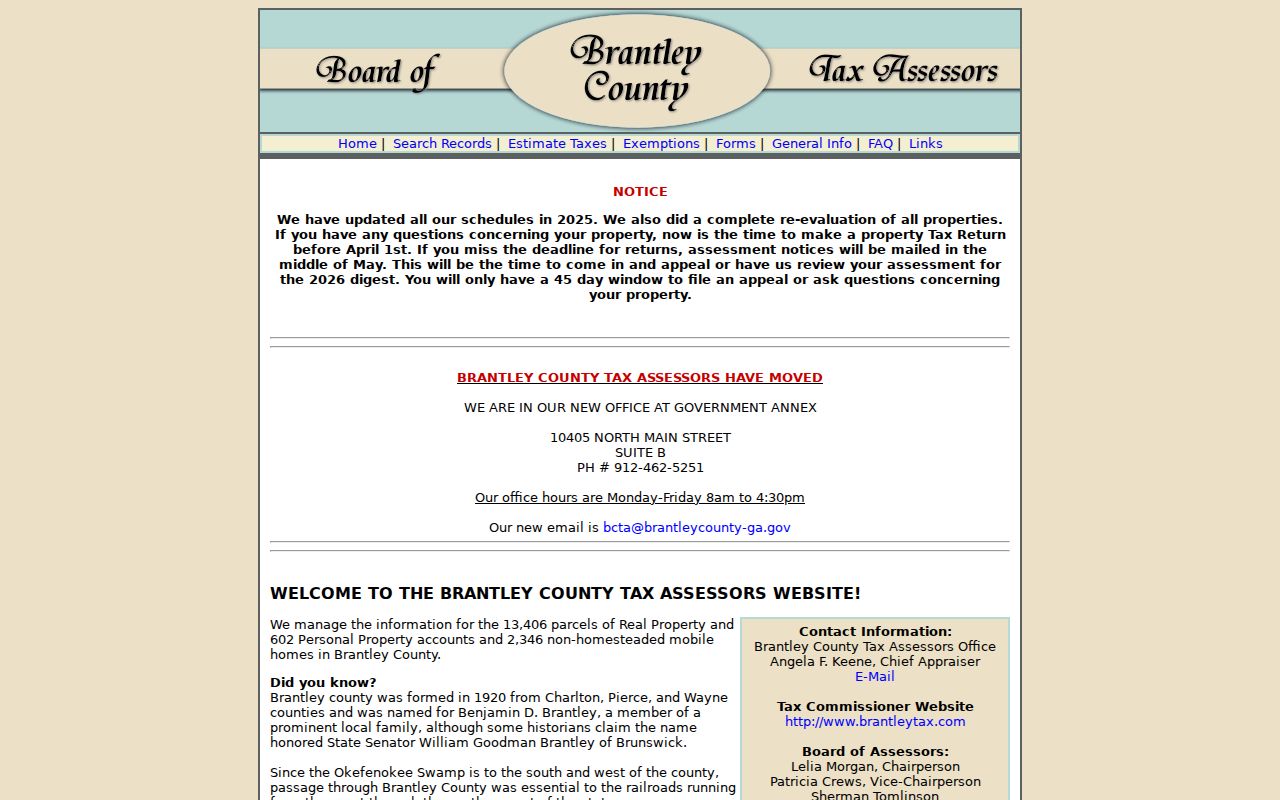
Use that page to enter the vendor search. Date the result, and confirm a recent owner change in the recorded deed rather than assuming the displayed name updated immediately.
Where Brantley County Property Ownership Appears
Each record shows a different slice of ownership. The roll is the convenient current lead. The deed records the transfer itself, the map points to the parcel's geography, and neither should be stretched beyond its job.
| Source | Owner Info It Gives | Access |
|---|---|---|
| Tax Assessor qPublic | Owner of record, mailing/situs clues, APN | Online; Assessor office fallback |
| Clerk / GSCCCA | Grantee and vesting in the latest deed | Index, courthouse, phone, mail, eCertification |
| Georgia Corporations Division | Entity status, agent, officers, filing history | Free business search |
| qPublic map / GIS Clearinghouse | Parcel geography used to identify the tract | Map link if available; data download |
An owner may live elsewhere. Brantley County parcels can carry a 31553 Nahunta or 31542 Hoboken mailing line, use a post-office box, or sit under an LLC, trust, estate, or life estate. Neither mailing address proves city incorporation. See Nahunta property records or Hoboken records for city context, since the county remains the custodian.
Trace a Brantley LLC or Trust Name
An LLC or corporation in the owner field calls for the Georgia Corporations Division Business Search. It runs Starts With, Contains, and Exact Match queries. You can search by business name, control number, registered agent, officer, or designated agent. Results may show status, entity type, effective date, offices, agents, officers, and filing history. A registered agent is a compliance contact. That role does not make someone the owner. Match the control number to the deed's grantee. Trusts and estates may need the recorded deed plus a Brantley County Probate Court file, since a deed of assent can move property without an ordinary sale.
- Owner of record
- The person or entity currently carried by the public property record.
- Grantee
- The party receiving an interest in a recorded conveyance.
- Situs
- The property's physical location, distinct from the mailing destination.
- Title
- The legal bundle of interests; identifying a record name is not a title opinion.
When Brantley's Roll Has Not Caught Up
The assessor publishes no standard deed-to-roll lag. For a recent transaction, pull the newest GSCCCA filing. Compare its grantee, legal description, parcel reference, and recording date with qPublic. A just-recorded deed can be fresher. An unrecorded closing document will not appear at all. For help, contact the Brantley County Clerk of Superior Court at 234 Brantley Street, Suite 200, Nahunta, or call 912-462-5635. The office is open 8:00 a.m. to 5:00 p.m. weekdays, and mail goes to P.O. Box 1067. GSCCCA eCertification offers electronically certified real-estate copies through an account.
Note: A tax bill names an account and mailing destination; it does not disclose every legal or beneficial interest.
Identify Brantley Estate Ownership Without Guessing
An owner field reading "Estate of," a personal representative's name, or a life-estate form rarely explains who holds authority now. The deed index alone will not settle it. Brantley County Probate Court, at 234 Brantley Street, Suite 100, Nahunta, handles local estate files and can be reached at 912-462-5192. Compare letters of administration, wills admitted to probate, public inventories or estate filings, and any deed of assent against the parcel's newest deed. A death certificate proves a death. It does not prove land ownership. Georgia vital records carry eligibility and fee rules, and the probate file may contain restricted material. Treat the death record only as a cross-check of date and identity. The deed or estate conveyance is the property evidence. A deceased owner's name may linger on qPublic. The heir is not yet owner of record.
Watch Brantley Filings With FANS
The GSCCCA Filing Activity Notification System lets you register names, addresses, and document types. You get an alert when something records. Deeds, liens, plats, and UCC filings are all covered. The service is free and voluntary. It went statewide in 2023 and passed 56,000 registered users by June 30, 2024. An alert can flag a suspicious filing early, though it cannot block or reverse one.
When an alert arrives, save the instrument reference. Pull the filing itself and call the Clerk if anything looks off. Any letter demanding payment for a deed copy should be checked against the official county directory. A private mailing is not proof that Brantley County took action.
What “Who Owns This Property” Cannot Establish
A public owner name has limits. It does not prove who lives in the house, settle disputes between competing claimants, or guarantee marketable title. Some names sit inside trusts, and a deed may not list every beneficiary. Protected addresses can also be missing or masked through Georgia Safe at Home or VoteSafe. When you save a result, keep the parcel ID, recording reference, legal description, source, and date. That way anyone can reproduce it later.
Not a title opinion. Use Brantley County owner records for lawful property research and due diligence. Never use an address or name to stalk, threaten, harass, or facilitate harm.
If a record is not online, go to its custodian. Ask in person, by phone, or in writing. Georgia's open-government guidance describes the standard three-business-day response window, along with costs and exemptions. That path gets you existing records. It never forces an agency to build an ownership analysis for you.
When two sources disagree, do not force an answer. Suppose qPublic lists one owner while a newer GSCCAA deed names a different grantee. Record both dates. Treat the deed as the newer transfer evidence while the tax roll catches up. Brantley County publishes no fixed deed-to-roll update interval. The gap can last a while. A tax-mail address shows where a notice goes. It does not prove where the owner lives or who occupies the land.
Entity and estate captions deserve the same caution. Run a business name through the Georgia Corporations Division for clues about identity. Check probate records to understand an estate. Still, come back to the recorded conveyance for the actual land interest. Trust details often stay private too. Beneficiary information may not be public. These limits keep a Brantley County owner search anchored to what the official record actually says.