
What Brantley County Deed Records Convey
The Brantley County Clerk of Superior Court handles the recording of deeds for the county. The same office records liens and plats. Every deed names its parties. It also describes the land and marks the transfer a party brought forward for record. Read the legal description closely. It carries far more weight than a tax mailing address ever will.
| Deed Type | What It Does | Common Use |
|---|---|---|
| Warranty deed | Conveys the stated estate with covenants | Ordinary sale |
| Quitclaim deed | Conveys whatever interest the grantor possesses | Family transfer or interest cleanup |
| Deed of assent | Transfers estate property through a representative | Probate distribution |
| Trustee deed | Records a transfer under trustee authority | Trust or power-of-sale context |
| Tax deed | Records a tax-sale conveyance | Delinquent-tax proceeding |
Georgia security deeds secure a debt. They are not the acquisition deed, and treating one as proof of ownership leads searchers astray. Assignments, cancellations, liens, and lis pendens filings all belong tied back to their original instrument references rather than counted as conveyances of title.
Brantley’s Deed Desk and Online Index
The Clerk’s office sits at 234 Brantley Street, Suite 200, P.O. Box 1067, Nahunta, GA 31553, and answers the phone at 912-462-5635. Doors stay open 8:00 a.m. to 5:00 p.m., Monday through Friday. An image will not load. An older index runs thin. A certified copy is required. In any of those cases, a trip to the counter is the dependable route. Do not confuse this court clerk with the county administrative clerk over at 33 Allen Road. They are separate offices with separate duties.
For online work, the GSCCCA Real Estate Index helps. It allows searching by name, property, book and page, county, date, party, instrument type, and geography. Statewide coverage reaches back to at least January 1, 1999. Brantley’s precise pre-1999 online cutoff has never been published.
| Field | Use | Caution |
|---|---|---|
| Party name | Find grantor or grantee | Try initials, estates, trusts, and entity variants |
| Instrument | Separate deeds, liens, and releases | Read the image for legal effect |
| Book/page | Retrieve a known citation | Preserve both values |
Choose the Correct GSCCCA Record System
Start at the official GSCCCA search landing page, then pick the real estate, plat, lien, or other index that matches the instrument you actually need.
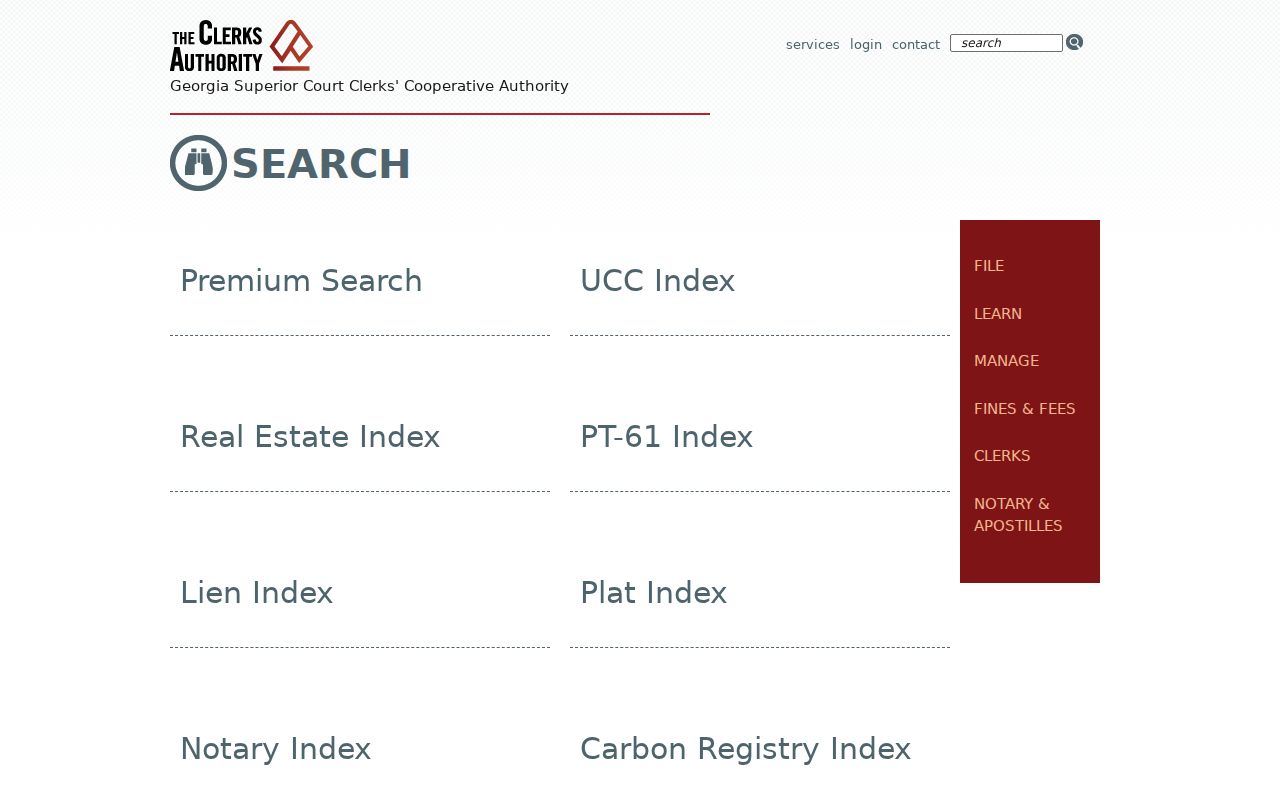
Record type matters on GSCCCA. Related instruments can sit in entirely separate search systems, so a thorough Brantley County property search means reconciling results across them.
Walk Brantley’s Grantor-Grantee Index
Start with the current owner listed as grantee on an acquisition deed. The grantor on that same instrument becomes the name you search next, moving backward through the index. Compare legal descriptions and prior-deed references at each step, since a single person may have conveyed several different parcels under one name.
- Find the newest acquisition deed with the current party as grantee.
- Read its grantor, description, book/page, and prior-deed citation.
- Search that grantor as an earlier grantee and verify the same land.
- Repeat to the online cutoff, then continue in deed books and archives.
- Grantor
- The party transferring the stated interest.
- Grantee
- The party receiving it.
- Chain of title
- The linked sequence affecting the same land.
- Book/page or instrument number
- The retrieval citation.
Before 1920, Search Three Predecessor Counties
Brantley County was cut from Charlton, Pierce, and Wayne counties in 1920. Any older land chain may therefore continue under one of those parent jurisdictions. The Georgia Archives guides researchers to county deeds, tax books, estates, Superior Court files, and Probate or Ordinary records. Many older volumes open with their own indexes up front.
The first county seat was Hoboken. In 1923 the seat moved to Nahunta. That is why record access today starts in Nahunta even for early Hoboken-area land. No courthouse fire destroyed Brantley’s deed records. Assume no such loss when a gap appears.
Note: The 1999 GSCCCA date is a statewide floor. It is not a promise that every earlier Brantley image appears online.
Link Brantley Deeds to Plats and Releases
A lot-and-block deed often cannot be read without its recorded plat. The GSCCCA Plat Index offers statewide online coverage reaching back to at least 2004, with searching by name or book and page. Rural Brantley County deeds take another shape entirely. Land lots, districts, roads, creeks, rail corridors, metes and bounds, and adjoining owners do the describing instead.
Pull the security deeds, assignments, cancellations, liens, lis pendens, easements, and releases surrounding the same parties and property. A release must connect to the encumbrance it cancels. An index label by itself proves nothing about validity or priority.
Free Alerts for New Brantley Filings
GSCCCA FANS launched statewide in 2023. It offers voluntary alerts on registered names, addresses, and document types. An alert can flag a matching Brantley County filing. But it cannot block fraud or void a document. Confirm anything it raises with the Clerk, then read the instrument itself. Stick to official contacts and refuse unexplained solicitation fees.
Use the Legal Description to Hold the Chain Together
Names alone never prove that successive deeds concern the same land. Match the county, acreage, lot and block, and subdivision and plat citation. Also compare the land lot and district, metes-and-bounds calls, and adjoining-owner references from deed to deed. Brantley County's rural roads, waterways, US 82, US 301, and the CSX corridors can complicate things. A historic description may lean on physical features that bear no resemblance to a modern situs address. Keep the parcel number as a handy cross-reference. Still, the recorded description controls the documentary comparison every time.
A plat shows how a parent tract became lots. It also shows where recorded roads run, and which deed cites the subdivision. It cannot substitute for a current boundary survey. qPublic's polygon helps locate the land. But it cannot cure an omitted parcel, a gap, an overlap, or an ambiguous deed call.
Separate Filing Fees From Copy Charges
GSCCCA’s real-estate e-filing guide lists statewide examples such as $25 deed or lien filings and $10-per-page plat filings. Those figures illustrate recording charges. They are not a confirmed Brantley County copy-price schedule. Anyone ordering an existing deed should ask the Clerk about plain copies. Ask also about certification, staff search time, mailing, and accepted payment. An eCertification request adds its own account-based payment authorization step. These are different transactions with different costs.
Keeping the distinction straight wards off misleading solicitations. Recording a new instrument, downloading an available image, receiving an office copy, and obtaining a certified secure PDF are four separate products. Name the product and the citation before you ask for a quote.
Estate Transfers Can Break the Simple Sale Pattern
Death can break a tidy buyer-to-seller chain. A probate file may hold the will, orders, and deeds of assent. Executor or administrator deeds and later corrective instruments are sometimes layered on top. Brantley Probate Court sits at 234 Brantley Street, Suite 100, Nahunta. The court can route local estate-file questions. Read probate material to learn who held authority and who inherited. Then return to the Clerk's deed records for the recorded land transfer.
Cemetery records and newspapers can separate similarly named people. They can also help locate an heir. Neither one substitutes for the deed. The Georgia Historic Newspapers collection includes the Brantley Enterprise from 1927–1973. It also holds an earlier Nahunta community-paper run from 1925–1926. Treat any notice as a date and identity clue. It must be reconciled with probate papers and recorded instruments.
Write a Deed Request the Clerk Can Retrieve
Give the clerk plenty to work with. For counter, telephone, or mail access, supply the grantor and grantee if known. Add the approximate recording date, instrument type, book/page or instrument number, and a brief property-description clue. Note whether a plain copy or a certification is needed. If the online result is only an index row, keep the citation. Ask whether the corresponding image exists at a courthouse terminal or in a physical volume.
Under the Georgia Open Records Act guidance, a custodian may charge lawful retrieval, redaction, supervision, copying, and mailing costs, and should explain timing and exemptions when a record cannot be produced promptly. The request should target existing records. It cannot ask the clerk to run a title examination.
Get a Brantley Deed Copy or Certification
Pick the route that fits your need. An online image works for research. Contact the Clerk for local copies. For an electronically certified document, use GSCCCA eCertification, where you select county and document type, submit a request, authorize payment, and receive a secure PDF. No Brantley-specific per-page copy schedule is published, so confirm current search, copy, certification, mailing, and payment charges before ordering.
Recorded, not guaranteed. Brantley County deed records show instruments accepted for recording; they are not a title opinion and may not reveal unrecorded interests.
Close the file with an inventory, not loose images. Add a row per instrument. For each Brantley County deed, log the execution date, recording date, grantor, grantee, instrument type, book/page or instrument number, consideration clue, legal description, plat reference, prior-deed citation, and the source of the copy. Put security deeds, assignments, releases, liens, lis pendens, easements, and corrective instruments on their own rows. Gaps stand out fast. A cancellation can no longer pass as a conveyance.
Older chains need one more habit. Document the jurisdiction at every step. Brantley did not exist before 1920. Depending on location, the same tract may be indexed in Charlton, Pierce, or Wayne before county formation. The 1923 county-seat transfer from Hoboken to Nahunta explains present courthouse routing, though it never changes the county named on a recorded instrument. A statewide search can dead-end. When it does, ask the clerk which deed book, reverse index, plat cabinet, microfilm, or predecessor-county reference continues the sequence. Georgia Archives tax, estate, Superior Court, and Probate or Ordinary materials can test identities and dates. The recorded deed remains the ownership evidence.