
Start a Brantley County Property Search
Start with the Brantley County Tax Assessor qPublic service. It accepts an owner name, a street address, or a parcel number. One result screen becomes the hub for a parcel. The roll links the situs address to the owner field and mailing address. It also carries the parcel identifier, legal description, values, exemption clues, and a map. A situs address is simply where the property sits. The mailing address can differ. That split trips up many searches, since no single screen proves every fact. The roll serves identification and taxation. A recorded deed from the Clerk is the real evidence of a transfer. A tax bill tracks one account. A parcel map gives reference geometry. The parcel number bridges all of them.
- Search qPublic with the street address. Try the owner name if the address fails.
- Save the parcel number, owner spelling, legal description, and any book-and-page clue.
- Use GSCCCA to find the newest deed and related recorded instruments.
- Open the Tax Commissioner's account for the bill and payment record.
- Compare the map, plat, and written deed before relying on a boundary.
Brantley County Records Custodians
Brantley County splits its core property records among three offices. The Clerk of Superior Court records deeds, security deeds, liens, releases, and plats. The Tax Assessor keeps parcel identity and value data. The Tax Commissioner bills and collects based on the digest. Reach the right custodian the first time. The administrative clerk on Allen Road cannot substitute for the Superior Court clerk on deeds. Nor can that clerk handle court files.
Clerk of Superior Court
234 Brantley Street, Suite 200
Nahunta, GA 31553
912-462-5635
Brantley Tax Assessor
10405 Main Street North, Suite B
Nahunta, GA 31553
912-462-5251
Brantley Tax Commissioner
10405 Main Street North, Suite D
Nahunta, GA 31553
912-462-5723
Online tools cover only part of the ground. The Clerk answers questions at the counter and routes certified copies through GSCCCA eCertification. Roll and account questions go to assessor and tax staff by phone or in person. Some county records are not posted online. A written Georgia Open Records Act request is the fallback in that case.
Brantley Deeds and Recorded Proof
The GSCCCA Real Estate Index is the statewide layer for Brantley County deed records. It searches by name, property, book and page, county, date, party role, instrument type, and geography. Coverage reaches back to at least January 1, 1999. Older transfers take more digging. They may sit in deed books, local indexes, the Georgia Archives, or predecessor-county files, because the online cutoff for early Brantley volumes is not published.
An index entry is a pointer, not the instrument. Pull the image or a certified copy. Only the full deed shows vesting language, consideration clues, legal description, reservations, and prior-deed references. Warranty deeds, quitclaim deeds, deeds of assent, administrator deeds, and tax deeds can all move an interest in land. Security deeds only secure debt. Never mistake one for an ownership deed.
The official GSCCCA search menu reaches further. Liens, plats, PT-61 forms, UCC records, and notary data all connect there, helping explain a title trail without turning a public search into a legal title opinion.
Brantley Values Changed for 2026
The 2026 digest marks a real break in Brantley County property records. All schedules were updated in 2025, and every property was fully re-evaluated for the new digest year. A gap between an old parcel card and the 2026 numbers may simply reflect that countywide work. Check the deed and permit trail before assuming a sale or new construction.
Georgia starts from fair market value. Ad valorem tax applies a 40 percent assessment level. Exemptions can then change the taxable value. The assessor mails annual notices in mid-May and allows 45 days to appeal or request review. The assessor's general information page explains the value framework. The tax office sets millage and maintains the bill.
When comparing values, preserve the year. Keep fair market value, assessed value, exemption status, and digest year in separate fields. That small habit stops unlike numbers from being read as the same measure.
Brantley County Property Record Types
Each record set answers one part of a property question. The table keeps those roles distinct and shows where a Brantley County search should move next.
| Record | Best Evidence For | Custodian | Practical Access |
|---|---|---|---|
| Deeds and liens | Transfers and recorded claims | Superior Court Clerk | GSCCCA, counter, certified request |
| Assessment roll | Parcel, owner field, value | Tax Assessor | qPublic, phone, office |
| Tax account | Bill and payment status | Tax Commissioner | Catalis site, drive-through, office |
| Plats and parcels | Recorded lot and map reference | Clerk and assessor | GSCCCA Plat Index, qPublic map |
| Permits and addresses | County approvals and address files | Planning & Building | Forms online, records in office |
The deed itself is the goal sometimes. Use the Brantley County deed records route then, since value, exemptions, and the tax bill live in different records despite a shared parcel number.
Brantley Parcel Maps Have Two Doors
Brantley County hosts no GIS viewer of its own. The practical map hangs off a qPublic assessment result. For bulk data, the Georgia GIS Clearinghouse provides Brantley parcel and CAMA downloads along with address points, roads, aerial imagery, contours, and land-lot or district data. CAMA stands for computer-assisted mass appraisal, the system behind many assessment fields.
Parcel formats in county notices show why exact copying matters. Examples like B011 108, B042-185, and 069B-001 keep letters, spaces, leading zeroes, hyphens, and suffixes. A shortened number may miss the result. Search the exact form first. Then test a careful variation.
The state parcel-data page shows the Brantley selection and download surface.
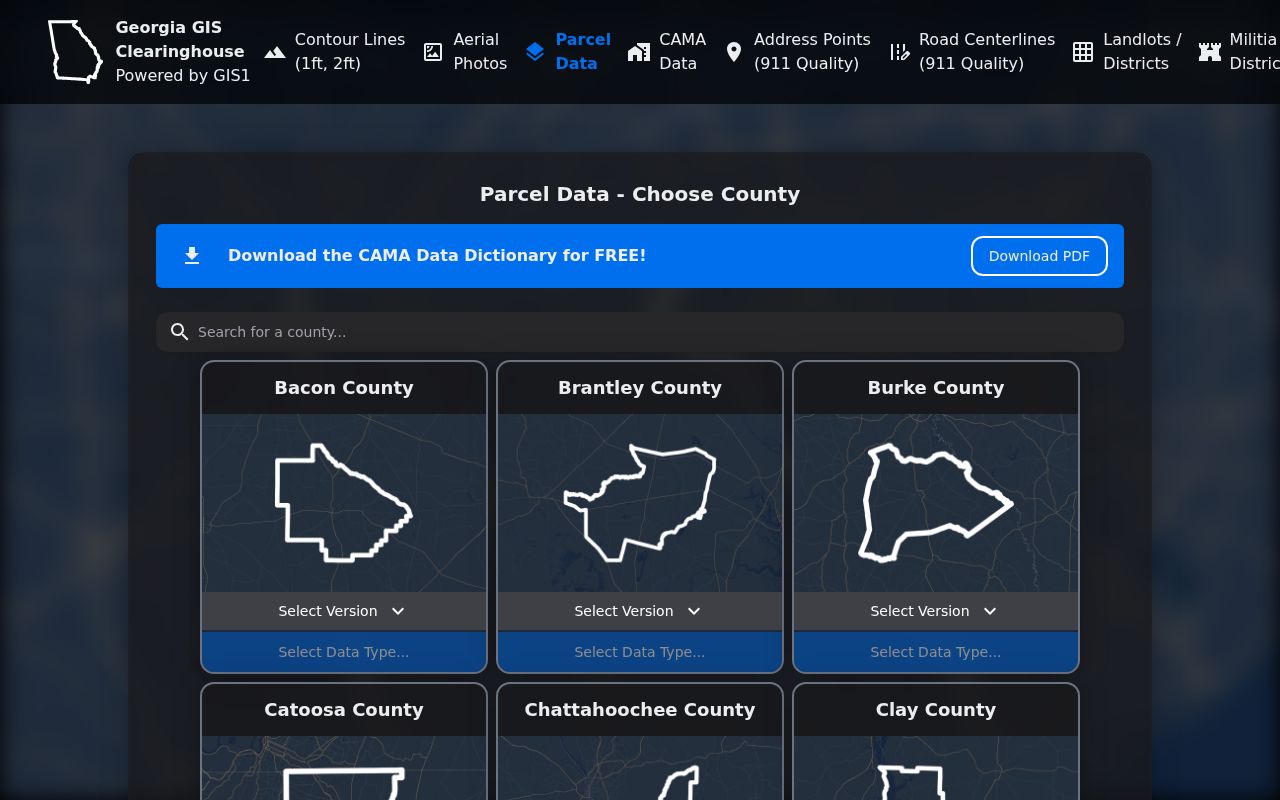
The qPublic download option supplies data layers rather than survey lines or a confirmed adjacent-parcel view.
Brantley Corridors Preserve Land Clues
Roads and rails often outlive street numbers. The Brantley County plan anchors US 82 and an east-west CSX line through Hoboken, Nahunta, Lulaton, Atkinson, and Waynesville. US 301 and a north-south rail line run through the Nahunta, Hortense, and Hickox corridor. Old deeds, easements, and plats lean on these fixed features. When a street search stalls, try the corridor instead.
Rural legal descriptions carry more clues than any address. Land lot, district, creek, road, railroad, acreage, and every adjoining owner named in the deed can reattach a parcel to its record. Copy each call exactly. Then lay the text beside the qPublic map, a recorded plat, the state parcel data, and the Georgia DOT county map. The DOT sheet itself warns that written road records control. Treat the graphics as finding aids only.
Boundary rule. A parcel line helps locate land, but only the deed, recorded plat, and a licensed survey address a disputed boundary.
Nahunta and Hoboken Address Traps
A Nahunta mailing line proves nothing. The county's two incorporated cities are Nahunta and Hoboken. ZIP mailing lines reach past their borders. Unincorporated communities like Waynesville, Atkinson, Lulaton, Hortense, and Hickox add another layer to the puzzle.
Treat the address as a mailing clue. The assessor map, a city-limit source, or the record custodian settles jurisdiction. Either way, deeds stay county records. So do assessments, tax accounts, and plats. The pages for Nahunta property records and Hoboken records stick to the corridor and boundary clues each town actually shows, without inventing subdivisions that no planning source names. Municipal lines mainly point you toward the right administrative file.
Note: Keep both the situs and mailing address, since either works as a search term and only one marks the parcel's site.
Brantley Permits Require an Office Route
Brantley County permits take an office route. Planning & Building posts its permit checklists online. The county's public notices page adds building, mobile-home, septic, water, and address-request forms. No online permit-history search exists. A blank result proves nothing about a paper file. The county states one instruction plainly: every new address request is completed in the office.
Written requests work best when they identify an existing record rather than ask staff to research a property. Give the situs and APN. Then add the applicant name, record type, and a tight date window. Building, septic, water, mobile-home, structure, and address files each use separate forms. Say which one you want. Road-abandonment or land-use minutes may sit with the administrative clerk. Planning keeps the application itself. Georgia's Open Records Act generally calls for production within three business days, or a written description of the timing, cost, and legal basis for anything withheld.
Neither Nahunta nor Hoboken wrote its own zoning ordinance in the 2021 joint plan. Start with county zoning and planning sources. A city clerk can still answer ordinance or administrative-file questions.
Custodian matters. The Tax Assessor sits in Suite B and the Tax Commissioner in Suite D of the Government Annex at 10405 Main Street North. The Superior Court Clerk is at 234 Brantley Street, Suite 200. A request sent to the right office avoids delay.
Old Brantley Property Records Cross Counties
Brantley County was born in 1920. Its land came from Charlton, Pierce, and Wayne counties. A title chain that crosses that year may leave the modern Brantley deed index and continue in a predecessor county's books. The legal description points the way. Land district, old road, waterway, and adjoining-owner names all help decide which older volumes to search.
The county seat adds a date clue. Hoboken held the courthouse first. The seat moved to Nahunta in 1923. A deed or legal notice from 1920 to 1923 that names Hoboken as the courthouse setting fits that history and should never be corrected to a modern Nahunta address.
When electronic coverage runs out, older deed books have not vanished; the GSCCCA floor only marks confirmed digital reach, so turn to the local Clerk, the Georgia Archives research guidance, and book-front indexes.
Newspapers Bridge Brantley Record Gaps
For decades when formal indexes run thin, newspapers fill the space. The Georgia Historic Newspapers archive carries the Brantley Enterprise from 1927 through 1973. It also holds an earlier Nahunta community paper covering 1925 through 1926. An owner of record can surface there when a deed index stays quiet. So can sheriff's sales, estate notices, road changes, business names, and full legal descriptions of land parcels. Later records abbreviate these.
Treat every notice as a lead rather than proof. Copy the surname, the date, the tract language, the type of sale. Add any book-and-page citation the printer included. That reference points back to the deed book, court file, probate file, or tax roll. The transaction actually lives there. Cemetery markers and probate papers can also reconnect an heir to a forgotten land trail. Just remember that a memorial entry never transfers title by itself.
Searching takes several angles. Run the owner's surname first. Then add a road, a rail line, a community name. Or use phrases like sheriff's sale, administrator, estate, or land lot. Names work best exactly as printed, because initials, married surnames, and estate captions breed false matches. Weigh each hit against the dates and tract wording. Hold the newspaper's phrasing at arm's length. Wait until the deed, court order, or tax proceeding confirms what truly happened.
Watch New Brantley Record Filings
Deed fraud worries many Brantley County owners. The GSCCCA Filing Activity Notification System, called FANS, offers a free early warning. Register a name, address, or document type to watch. When a new deed, lien, plat, or UCC filing enters the statewide index, FANS sends an alert. That notice is a watch layer, nothing more.
FANS cannot block a false filing, validate a signature, or substitute for a title search. Save the alert. Open the indexed filing and call the Brantley County Clerk of Superior Court if anything looks wrong. A certified copy carries far more weight than an alert email. Get legal advice when a recorded claim touches title.
The official FANS registration screen shows the statewide service.
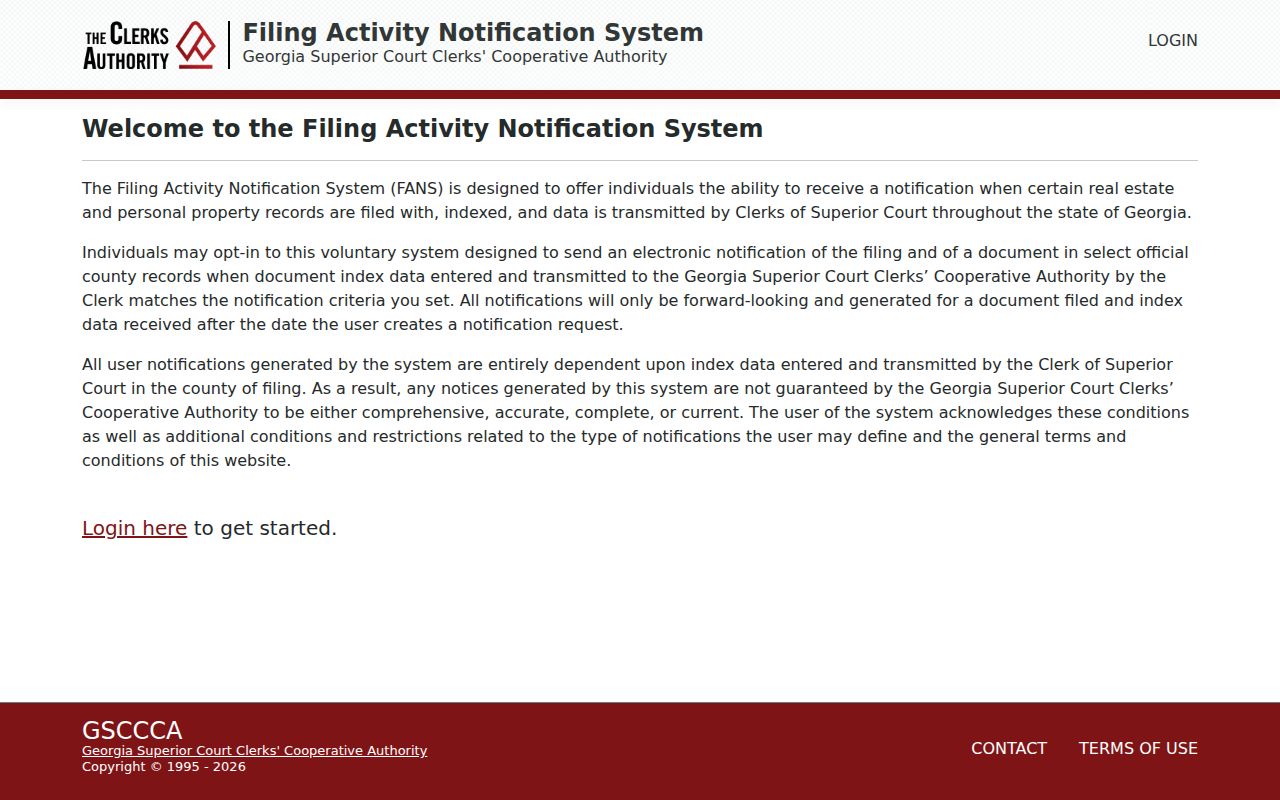
The Clerk, not FANS, remains custodian of the instrument.
Limits of Brantley County Property Records
Every record has its own lane. The assessor carries the owner of record on the tax roll and values each parcel for the digest. A deed records stated interests and legal text. The tax account tracks billing and payments. The map places a parcel polygon. None of these, standing alone, proves that every easement, boundary condition, unrecorded claim, or title defect has surfaced.
Serious due diligence calls for a full packet. Pull the current parcel card, the newest deed, any relevant prior deed, the tax account, the recorded plat, lien and security-deed results, and any permit response. Record your retrieval dates. Brantley County property records change over time. A quick web lookup, certified instruments, a title examination, and a survey each answer different questions.
When a public portal fails, keep moving through the documented access chain. Call the office with your parcel number. Ask whether the index or image you need sits on a public terminal. A mail request should name the record type, the parties, the date span, and the book and page when known. For older land, the Georgia Archives and the historic newspaper collection often hold the next index clue. County administrative material that never gets posted can be requested under the Georgia Open Records Act. Agencies may charge lawful search, retrieval, redaction, supervision, copy, and mailing costs. A narrow request is usually faster and cheaper.
Lawful use. Brantley County property records support due diligence, boundary research, estate work, and civic review. Never use owner data to stalk, harass, or harm a person.