
What Brantley County Property Tax Records Show
Two offices split the work. The Tax Assessor keeps valuation and exemption records, while the Tax Commissioner issues and collects Brantley County tax bills, so read both sides of the same parcel and tax year.
| Field | What It Shows | Where |
|---|---|---|
| Fair market value | Assessor’s estimate of full value | qPublic |
| Assessed value | Georgia’s assessment measure, generally 40% of fair market value | Assessor |
| Exemptions | Homestead or specialized treatment | Assessor |
| Tax bill & status | Amount billed, paid, or delinquent | Tax Commissioner |
| Millage | Rates applied to taxable assessment | Bill and public notices |
Assessed value is not a sale price. Exemptions can shrink taxable value, while deeds and PT-61 filings supply the actual transaction evidence inside Brantley County property records.
The 2026 Digest Follows a Full Re-evaluation
Brantley qPublic updated its schedules in 2025. Every property then received a full re-evaluation for the 2026 digest. That makes the tax year essential when comparing values. A jump may reflect the digest update rather than a sale. Review the assessor's official valuation guidance before drawing conclusions about any parcel.
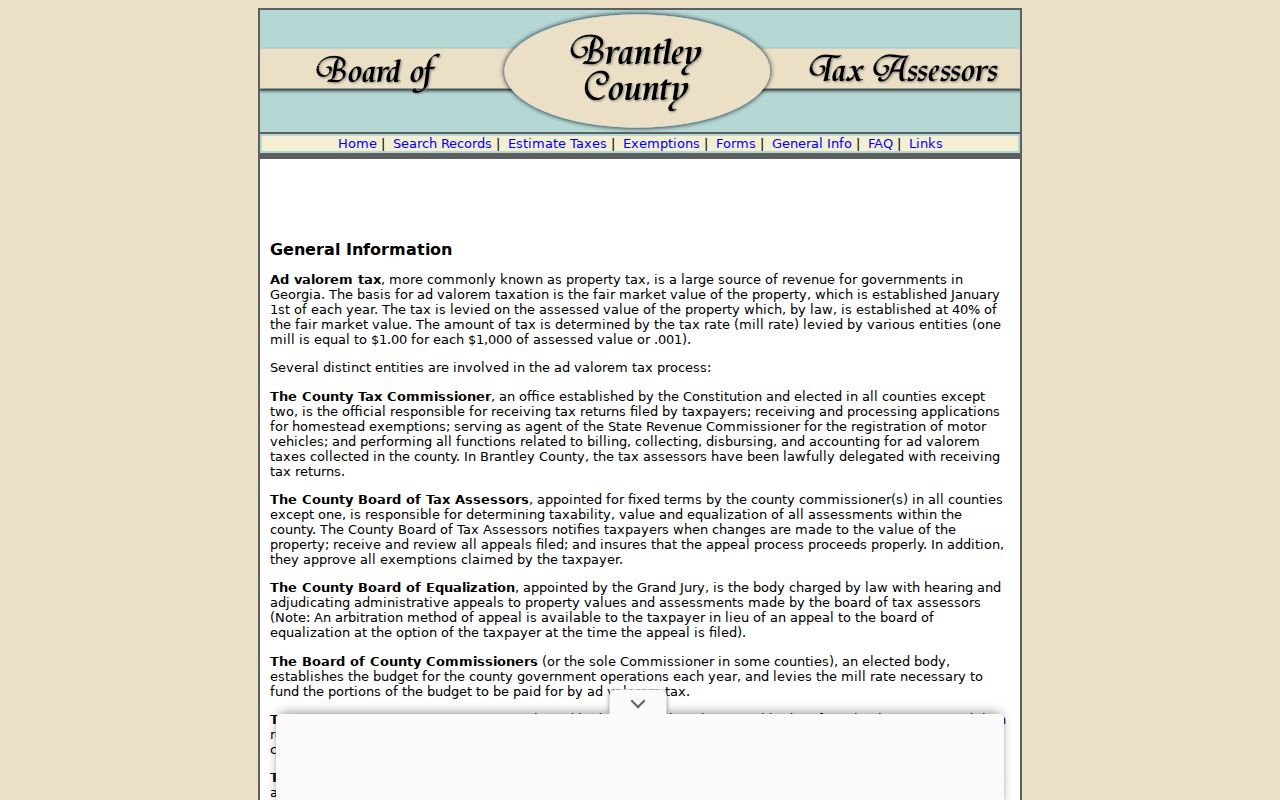
The assessor's method page explains fair market value, the 40-percent assessment level, and millage calculation. Parcel figures still demand the correct digest year.
Brantley Exemptions Change Taxable Value
Several programs can shrink a parcel's taxable value in Brantley County. The exemption guidance walks through homestead, preferential, and specialized options. It also covers conservation use, agricultural treatment, transitional property, and Freeport. Standard homestead paperwork plus age-based, agricultural, and current-use forms sit on the forms page for download.
Timing matters with these programs. Homestead status hinges on owning and occupying the home on January 1. Conservation use works differently, since it binds land under a ten-year covenant. Check eligibility windows, filing deadlines, and what happens if the covenant is broken. Do all that before counting either one as savings.
Open the current exemption source straight from the county for the latest details.
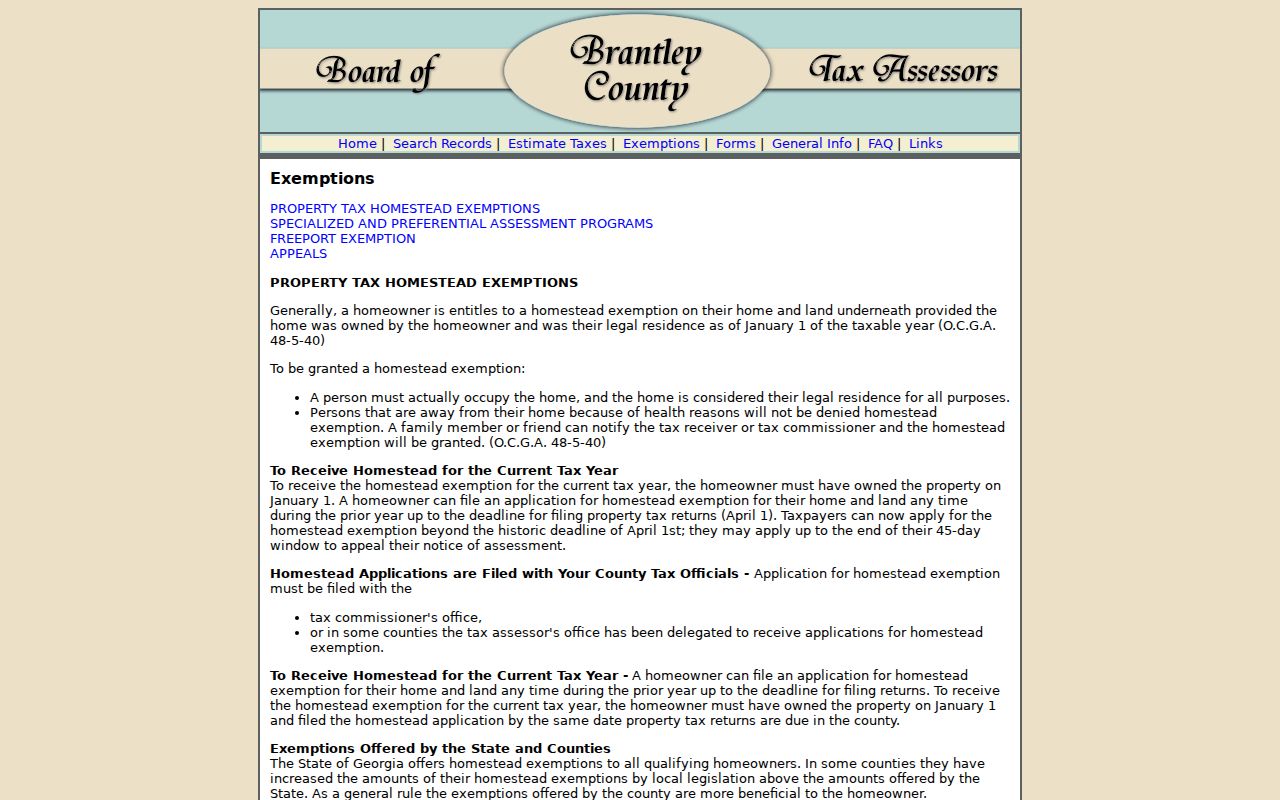
Old parcel flags never prove a new owner's eligibility.
Look Up a Brantley County Tax Bill
Grab the parcel number from qPublic first. Use it to reconcile the valuation card with the tax account, since the Tax Commissioner portal handles bills and payments rather than owner-title questions.
- Find the parcel and digest-year assessment in qPublic.
- Match the parcel and tax year in Catalis.
- Read bill and payment status, then compare exemptions.
- Verify delinquency and sale notices directly with the Commissioner.
- Assessed value
- The statutory assessment measure.
- Millage
- The rate applied to taxable assessment.
- Homestead exemption
- Qualified owner-occupant relief.
- Tax lien
- A public claim for unpaid tax, distinct from a deed.
The Commissioner Bills What the Assessor Values
The assessor never collects tax; the commissioner never sets fair market value. The official Brantley tax site also posts office-move and drive-through details, hours, mailing-address updates, and tax-sale news.
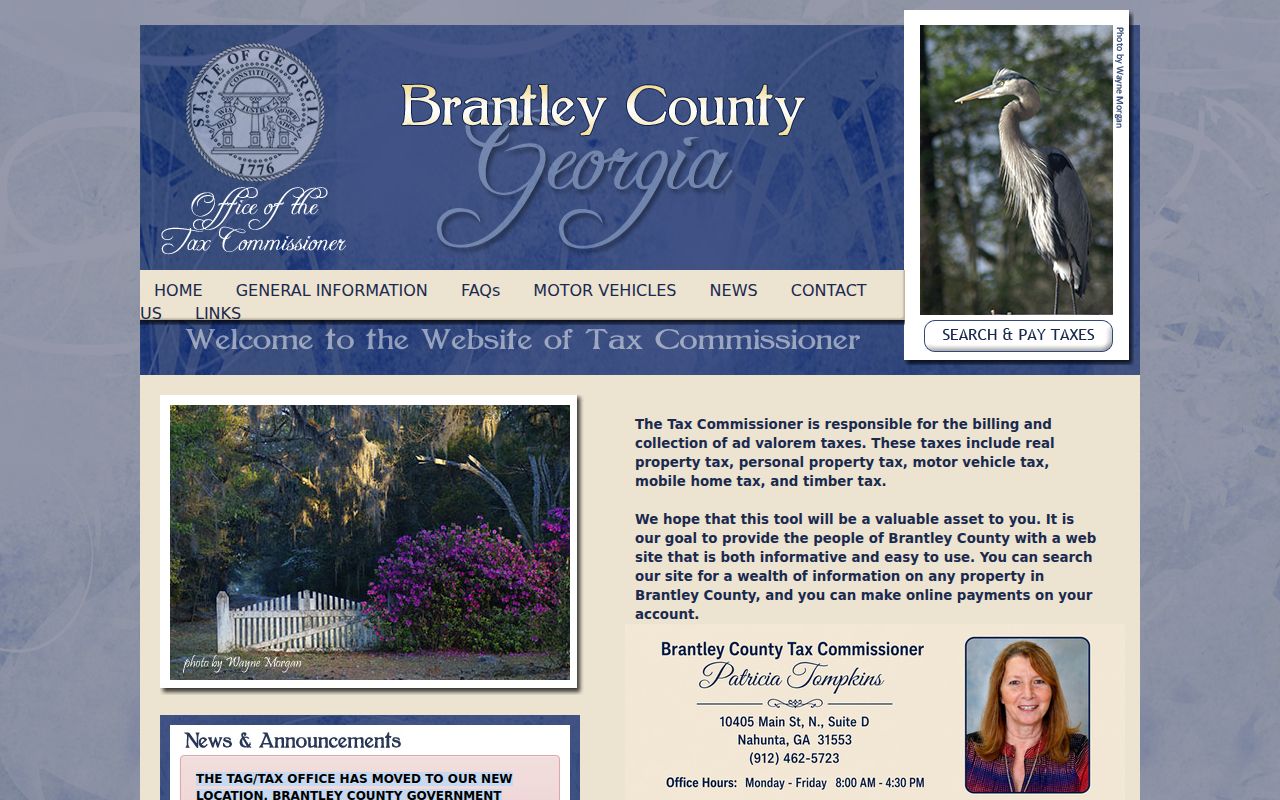
Think of the portal as the bill doorway. Recorded ownership stays with the Clerk, and valuation questions belong to the assessor.
Date-Check Every Brantley Tax-Sale Notice
The commissioner posts tax-sale news. County public notices offer another official channel. Delinquency, lien, levy, advertisement, sale, and tax deed are separate stages, each with its own evidence. The Brantley County Express may print legal notices, but payment, postponement, cancellation, or redemption can change the trail, so confirm current status directly.
Build a Parcel-Specific Appeal Record
A sound valuation appeal stays focused on one property and one tax year. Save the assessment notice. Keep the qPublic card too. Add photographs dated near the valuation date, sketches or measurements exposing wrong characteristics, repair records, and comparable sales that genuinely match the subject. If acreage, lot configuration, access, or improvements are wrong, name the exact field. Supply the record that supports each correction. A tax bill is not valuation evidence. It applies rates set after assessment and exemptions. A recent purchase price is shaky unless the sale was arm's length and the statutory valuation date lines up. Disputed exemptions need their own proof: ownership, occupancy, age, disability, agricultural, or conservation-use documents for that program.
Read Delinquency as a Sequence, Not a Label
An unpaid balance is only the start. Record the tax year, account, amount, and payment-posting date. Note any interest or penalty figures and the date you checked the portal. Then ask the harder question. Does a lien, levy, advertisement, scheduled sale, completed sale, or tax deed exist? Each stage carries different evidence and consequences. An old online page can lag behind a recent payment or cancellation. Search the commissioner's current tax-sale news, Brantley public notices, and the relevant newspaper notice before confirming directly with the office. Pull any recorded tax deed from the Clerk. Review any redemption or later title material rather than treating the advertisement as the final ownership record.
Reconcile the Brantley Tax Calculation
Start with fair market value and apply Georgia's 40-percent assessment level. Subtract exemptions or preferential treatment. Then apply the relevant millage. A bill can bundle several taxing components, so two bare totals reveal nothing about whether value, exemption, millage, delinquency charges, or a correction moved. Build a worksheet instead. Cite the source date for every number. Conservation-use valuation deserves extra care, since a covenant can change taxable treatment without touching the land's ordinary market evidence. Homestead relief lowers taxable value, not the recorded price. Those distinctions keep a Brantley County property tax records review pointed at taxation, not title.
Keep the Brantley Tax Mailing Address Current
The Tax Commissioner's site publishes a mailing-address update notice, and that address controls where tax correspondence travels. It is not the parcel's situs. Nor does it prove occupancy. Compare mailing address, location address, and legal description whenever a notice seems aimed at the wrong parcel. A postal line sets no city limits. Brantley County has only two incorporated cities, Nahunta 31553 and Hoboken 31542, and rural delivery territory extends beyond municipal boundaries. Postal labels never change the bill.
Returns, Review, and the Annual Record Cycle
Georgia starts with fair market value. Assessable property is generally taxed at 40 percent of that figure once exemptions come off. From there the cycle moves in stages. The assessor studies each property's characteristics and builds the digest. Local taxing authorities then set the millage. The Tax Commissioner applies the resulting charge to each account. Keep the pieces straight: a return, an assessment notice, an appeal, and a tax bill are four distinct documents. Each arrives at its own point in the year.
Comparing years takes discipline. Pull the land value, improvement value, total fair market value, assessed value, exemptions, taxable value, millage, billed amount, and payment status for each tax year. The bill alone tells you little. A good comparison names which field actually moved. A rising total can come from value, rate, or a lost exemption.
Use Every Brantley Tax Access Channel
Start online. qPublic and Catalis carry Brantley County property tax records for most parcel searches. If the parcel will not surface, go to the assessor for roll and valuation details, then to the Tax Commissioner for bill, payment, delinquency, and mailing questions. The Georgia Department of Revenue county property-record directory confirms the assessor route, while its online payment directory confirms the commissioner route for paying a tax bill.
Nothing posted? Ask in writing. A focused request should name the parcel, the tax year, the document wanted, and the preferred format. Georgia's Open Records Act generally demands production within three business days, or else an explanation of timing, cost, and any exemption claimed. Staff still will not calculate a new value or hand out tax advice.
Appeal a Brantley County Assessment
Timing drives everything. Brantley mails assessment notices in mid-May and allows 45 days from the notice date to appeal or seek review, so use the date printed on your notice rather than a general rule of thumb. Strong evidence helps: the parcel card, photographs, corrected characteristics, comparable sales, a survey or plat where it matters, and exemption proof. File everything and keep copies. Board of Equalization records stay with the Clerk.
Appeal window. File within 45 days of the assessment notice, using the date printed on that notice rather than assuming a fixed calendar deadline.
Build the appeal file from the notice outward. Write down the notice date, the statutory deadline, the parcel number, and the digest year. Add the fair market value, assessed value, exemptions, and the specific property characteristic under challenge. Hang onto the envelope or delivery proof. Keep the signed appeal, the submission confirmation, and every piece of correspondence. If the case reaches the Board of Equalization, arrange exhibits with care. Each proposed correction should point to a photograph, measurement, deed, plat, or dated sale record.
The 2026 Brantley digest calls for extra care. It follows the assessor's 2025 schedule update and full re-evaluation. The numbers may shift sharply. Compare the new figures to the prior digest piece by piece. Check land, improvements, total market value, assessed value, exemption, and taxable value. Arguing from the final bill alone invites error. Millage arrives later. A changed total can trace back to value, rate, exemption, or delinquency charges rather than any single cause.
Some disputes need different records. An ownership question belongs with the newest recorded deed. A boundary question may call for a survey. Sorting these issues apart sends each question to the office actually authorized to answer it.